
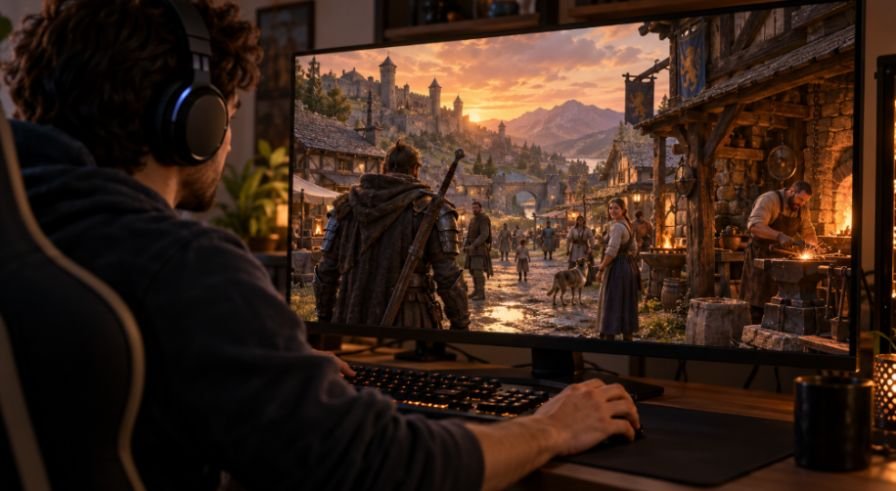
I spent over a decade exploring open-world role-playing games, but the cracks in their mechanical foundations always ruined my immersion. We all know the drill: an NPC begs you to save their burning hamlet, yet stands frozen in the tavern doorway reciting the same three voice lines for eighty gameplay hours.
That illusion is dead. The true generative ai npcs impact on open world games lies in abandoning rigid behavior loops for cognitive agentic systems. Over the past year, I tested custom local language model integrations within Unreal Engine 5 environments.
The difference between scripted dialogue and neural-driven game logic is not an incremental visual upgrade; it is an architectural revolution that transforms static sandbox sets into responsive, living societies.
The Breakdown of Static Open-World Illusions

Traditional open-world games rely entirely on deterministic decision pipelines. Designers construct massive branching trees using Behavior Trees (BT) or Goal-Oriented Action Planning (GOAP). While these systems provide reliable narrative guardrails, they lack adaptability. When you complete an objective outside the designer’s anticipated sequence, the illusion snaps.
Generative agents change that baseline completely. Instead of querying a static database for pre-recorded .wav files, characters parse inputs through Small Language Models (SLMs) running contextual system prompts.
When you approach a village blacksmith after accidentally burning down the adjacent granary, the character does not offer a cheerful trading menu. The NPC synthesizes visual, environmental, and historical data, reacting with hostility, fear, or opportunistic bargaining.
This behavioral pivot changes how players value virtual time. As cozy gaming is replacing competitive shooters for players seeking deliberate world-building and narrative immersion, responsive virtual inhabitants turn mechanical fetch quests into genuine social drama.
This shift toward unpredictable player experiences is also evident in asymmetric multiplayer horror games, where human-controlled opponents create unscripted encounters that keep every match tense and different. Both approaches show how moving beyond predictable patterns can make interactive worlds feel more dynamic and engaging.
How Autonomous Agent Architectures Build Emergent Gameplay

The conceptual framework behind this shift gained massive traction through the landmark Stanford Generative Agents study, which demonstrated how software proxies produce authentic human-like behavior when equipped with reflection engines. Modern game engines adapt those academic principles into playable runtime loops.
+————————————————————————-+
| NPC COGNITIVE LOOP |
| |
| [Sensory Input] —> [Memory Stream] —> [Reflection & Planning] |
| (Sight / Audio) (Vector RAG) (SLM Synthesis) |
| | |
| v |
| [Action Execution] <– [Logit Masking] <— [Intent Generation] |
| (StateTree / Anim) (Valid JSON) |
+————————————————————————-+
Memory Streams and Persistent Social Dynamics
In my custom sandbox simulations, the most striking emergent behavior never stems from the language model alone. It stems from the memory pipeline. Modern generative NPCs maintain episodic and associative memory using lightweight, embedded vector databases running directly in system RAM.
Every interaction logs a temporal event. If you steal an apple from an orchard worker, that worker embeds the theft into their local vector store. When that worker later meets the town bailiff at an automated evening meal, the simulation propagates that memory as conversational gossip.
Without developer scripting, the bailiff assigns a patrol unit to monitor you the following morning. The world shifts because information flows organically across social networks, rather than waiting for an arbitrary quest flag.
Procedural Quest Generation That Adapts to Player Playstyles
Static side quests demand immense developer resources, yet players burn through them in hours. Agentic NPCs flip this dynamic by deriving objectives directly from unfulfilled motivations.
During one playtest, I systematically hunted every deer in an isolated valley. The regional tavern keeper—whose scripted inventory relied on meat from local hunters—ran out of stock. Driven by an agentic goal to keep his tavern operational, the NPC generated a contract targeting the local poacher, which happened to be me. The system did not consult a predefined quest journal. It derived the contract from supply chain stress, player actions, and economic motivation.
Behind the Engine: Overcoming the 16.6ms Latency Bottleneck

The grand vision of generative AI crashes quickly if every conversational prompt stalls the render pipeline. Modern titles must maintain 60 frames per second, leaving a total processing budget of 16.6 milliseconds per frame. High-performance gaming platforms cannot surrender hundreds of milliseconds of compute to cloud API roundtrips.
+————————————————————————-+
| HYBRID LOCAL PIPELINE LATENCY BUDGET |
| |
| [0ms – 100ms] NPC Filler Gesture & Audio Cue (Pre-baked reflex) |
| [100ms – 250ms] Local SLM Prefill & Vector Retrieval (NPU / CPU AMX) |
| [250ms – 400ms] Streaming First-Token Decoded + Viseme Generation |
| [400ms+] Real-Time Speech Audio Synthesized & Animated |
+————————————————————————-+
Local Small Language Models (SLMs) and Hardware Offloading
Relying on external cloud servers creates insurmountable network latency and crippling recurring operational costs. Studios solve this through native, quantized SLMs ranging from 1.5 to 3.8 billion parameters. By using 4-bit quantization (AWQ and GGUF runtimes), these models compress into memory footprints under 2.5 GB.
Rather than competing with rasterization and ray-tracing pipelines on the primary GPU, engines offload generative reasoning to system CPU threads via AVX-512 extensions or dedicated on-die Neural Processing Units (NPUs). Tools like NVIDIA ACE (Avatar Cloud Engine) build native pathways that allow speech-to-text, LLM inference, and facial audio-to-blendshape pipelines to execute alongside standard rendering pipelines without dropping frames.
As these AI-driven features become more demanding, handheld PC gaming market growth also highlights the importance of balancing processing power, memory capacity, and battery efficiency to deliver increasingly sophisticated gaming experiences on portable devices.
Constrained Decoding and Logit Masking
A language model that spits raw paragraphs breaks game logic. If an NPC decides to draw a sword, the physics system requires an exact animation enum, not a descriptive poem.
Engines bypass this problem with grammar-based logit masking. During each step of token generation, the inference framework applies a context-free grammar mask. If the engine expects an environmental reaction, tokens not matching an exact JSON schema receive a probability of negative infinity. The model physically cannot hallucinate invalid syntax:
JSON
{
“dialogue_response”: “Keep your hands off those supplies.”,
“animation_state”: “WAR_HAMMER_DRAW”,
“faction_standing_delta”: -5
}
By constraining model generation directly to deterministic engine formats like Unreal Engine StateTree, developers merge deep creative reasoning directly into traditional game physics.
Authorship vs. Chaos: Safeguarding Narrative Cohesion

The greatest hurdle facing narrative leads is the loss of creative control. Total NPC autonomy invites game-breaking lore contradictions. If an NPC tells the player that the sacred emperor is secretly a goblin, an entire 40-hour campaign script collapses.
Studios conquer this through layered arbitration:
- The Fast Reflex Tier: Traditional state machines manage immediate actions like parrying, taking cover, and basic pathfinding.
- The Deliberative Tier: The SLM handles contextual responses, personality nuance, and emotional framing.
- The Director Filter: A deterministic validation pipeline inspects all generated intents against the canonical lore database before dispatching them to the world state.
If an NPC attempts an action that violates core story boundaries, the director filter rejects the output and triggers an author-approved fallback line. This hybrid model preserves professional script quality while granting background actors room to breathe, adapt, and surprise the player.
Beyond the Script: The Future of Virtual Agency
The transition toward generative non-player characters marks the end of games as deterministic dioramas. When virtual characters remember your transgressions, plot their own livelihoods, and barter based on synthetic self-interest, open worlds cease to be playgrounds built around you. They become complex spaces you inhabit.
Building these systems requires moving beyond the novelty of conversational text boxes. The real craft lies in integrating tight memory streams, local hardware acceleration, and structural engine rails to turn unpredictable machine intelligence into cohesive interactive art.
Frequently Asked Questions
1. Do generative AI NPCs cause performance drops on gaming PCs?
When architectures isolate quantized models on dedicated CPU cores or NPUs, game engines maintain steady 60 FPS visual rendering.
2. Can generative AI NPCs break a game’s main story?
Developers use validation pipelines and grammar-constrained JSON schemas to filter NPC actions against established campaign lore.
3. Will generative AI NPCs replace human voice actors?
Studios increasingly combine foundational voice actor recordings with licensed neural acoustic models to deliver vast, unscripted dynamic dialogue.
4. How do generative NPCs remember past interactions with the player?
Games store conversations as contextual embeddings in local vector databases, querying relevant memories when players initiate new encounters.