

A blood trail ending at a locked door can tell players more than a five-minute cutscene. That is the peculiar strength of environmental storytelling: the player does not simply receive a story. They investigate it.
Understanding how game developers design environmental storytelling means looking beyond attractive scenery. Designers carefully control architecture, props, lighting, pathways, sound, damage, and even empty space so players can infer what happened before they arrived. The result works because discovery becomes part of gameplay rather than a break from it.
What Is Environmental Storytelling in Games?
Environmental storytelling communicates narrative information through the playable world itself. A ruined apartment, abandoned birthday cake, overturned chair, and hastily packed suitcase can collectively suggest an evacuation without a character explaining it.
Research from MIT describes game spaces as places players actively interpret rather than merely observe. Clara Fernández-Vara’s work on “indexical storytelling” goes further, arguing that physical traces can encourage players to reconstruct events from evidence.
This distinguishes environmental storytelling from conventional exposition. Dialogue tells you a laboratory failed. Environmental design lets you discover shattered containment glass, emergency lights, claw marks, and an abandoned security station. The second approach makes the player mentally complete the story.
How Do Developers Build Stories Into Physical Spaces?
Developers usually work across several storytelling scales rather than treating every prop as an isolated clue.
Small Scenes Explain Individual Events
The smallest layer is the environmental vignette. Imagine entering a bedroom and finding an open window, muddy footprints, a broken lamp, and an untouched wallet. Nothing explicitly says someone fled quickly, yet most players can construct that possibility.
Southern Methodist University research into environmental storytelling and semiotics has examined how icons, symbols, and visual evidence communicate narrative information to players.
Strong vignettes generally contain enough evidence to trigger interpretation without making every detail painfully obvious.
Architecture Explains Society
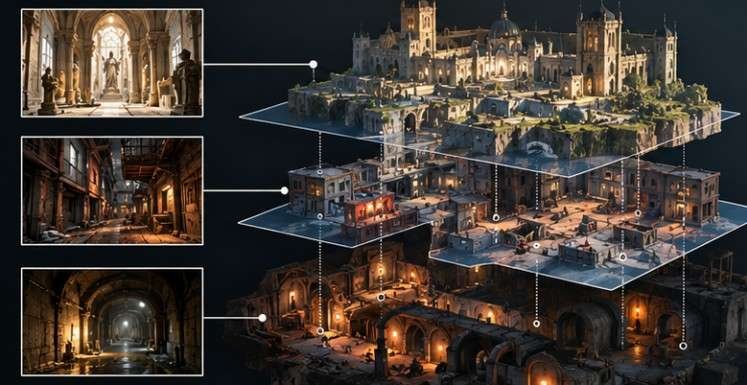
Zoom out and entire buildings can communicate hierarchy. Workers might live inside narrow concrete corridors beneath enormous machinery, while executives occupy spacious rooms overlooking the city. Without reading a document, the player understands something about power.
Architecture can also reveal a location’s previous purpose. A hospital converted into a military checkpoint should retain enough medical infrastructure that players can recognize its history beneath the newer barricades and equipment.
Research on game space from Georgia Tech emphasizes that players understand virtual locations through perception, movement, interaction, rules, and fictional context rather than visuals alone.
World Design Reveals Long-Term History
The widest layer concerns civilization-scale history. Old temples beneath newer cities suggest societies built on top of older cultures. Abandoned highways disappearing beneath forests imply considerable time has passed. Repeated faction symbols can reveal territorial expansion long before a character discusses politics.
Great world-building therefore feels layered rather than freshly constructed for the player’s arrival.
Why Does Cause and Effect Make Environments Believable?
One useful development technique starts with a simple question:
What happened here?
Designers can work backward from the answer.
Suppose the intended story is that survivors tried unsuccessfully to defend a grocery store. The environment might contain:
- Shelves dragged toward the entrance.
- Furniture reinforcing a side door.
- Empty ammunition containers behind cover.
- Damage concentrated around one access point.
- Supplies abandoned near an attempted escape route.
Each clue has a cause.
This matters because random clutter does not automatically become storytelling. A room containing fifty detailed objects may still communicate nothing if those objects have no relationship.
A 2024 Clemson University MFA project specifically used an explorable murder scene to study environmental storytelling, encouraging players to construct their own interpretation from spatial evidence.
How Do Lighting, Color, and Scale Control Emotion?
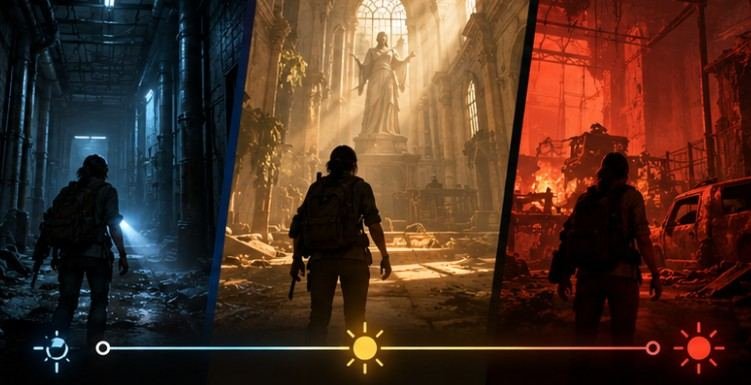
Not every environmental story describes a literal historical event. Sometimes the environment’s job is emotional.
Developers manipulate:
- ceiling height
- corridor width
- visibility
- shadows
- sound distance
- color temperature
- object density
- vertical scale
- movement speed
A narrow tunnel with poor visibility creates different expectations from a sunlit valley visible for miles.
Horror games routinely compress space before encounters because restricted movement increases uncertainty. Adventure games often do the opposite, revealing enormous landscapes after confined sequences to produce relief or awe.
Lighting also establishes hierarchy. A single illuminated doorway inside a dark structure does two jobs simultaneously: it guides navigation and makes the destination appear important.
That efficiency is valuable. The strongest level-design choices often serve gameplay, narrative, and atmosphere at once.
Why Is Player Discovery Better Than Constant Exposition?
Environmental storytelling changes the player’s relationship with information.
Traditional exposition pushes information toward the audience. Environmental storytelling frequently lets players pull information from the world.
That distinction creates agency.
A player who voluntarily investigates an abandoned office, notices photographs, connects names on documents, and discovers a hidden room has participated in uncovering the narrative.
Research collected by the U.S. Department of Education’s ERIC database has found that narrative features in serious games can contribute to immersion, engagement, motivation, and learning, although effectiveness depends heavily on how narrative is integrated into gameplay.
This also explains why optional content can become memorable. Modern games increasingly place meaningful narratives away from the critical path, something also visible in the evolution of video game side quests and optional storytelling.
What Games Demonstrate Environmental Storytelling Well?

BioShock remains a famous example because Rapture’s physical decay mirrors the collapse of the society that created it. The city is not merely a backdrop. Its architecture, advertisements, abandoned businesses, ideological imagery, and damaged infrastructure continually reinforce the central conflict.
The Last of Us frequently builds smaller human stories through abandoned homes, makeshift defenses, personal possessions, and traces of failed survival.
Dark Souls uses geography differently. Ruins, interconnected locations, monuments, item placement, and architectural layers encourage players to reconstruct a much older history.
Even music can strengthen these spaces. A location’s visual narrative becomes considerably more powerful when its atmosphere and score support the same emotional idea, which is why memorable video game soundtracks often feel inseparable from their environments.
Where Can Environmental Storytelling Go Wrong?
More detail does not automatically produce better storytelling. The biggest mistake is meaningless clutter. Thousands of carefully modeled objects cannot replace narrative logic.
Another problem is excessive subtlety. Developers sometimes know their fictional history so well that they assume players will understand tiny clues without adequate context.
Environmental storytelling also should not replace dialogue universally. Complex motivations, interpersonal conflicts, humor, and precise plot developments may require characters to speak. The best games combine methods. Environments suggest. Characters clarify. Mechanics reinforce.
Frequently Asked Questions
1. What is environmental storytelling in video games?
It is the practice of communicating narrative through spaces, objects, architecture, lighting, sound, damage, and other environmental clues rather than relying entirely on dialogue or cutscenes.
2. How game developers design environmental storytelling effectively?
Developers establish an event, identify its physical consequences, place readable clues throughout the environment, guide attention through level design, and playtest whether players can reconstruct the intended story.
3. Why is environmental storytelling effective?
It turns players into active interpreters. Discovering evidence and connecting clues can make narrative information feel earned rather than simply delivered.
4. Does every game need environmental storytelling?
No. It works especially well in exploration-heavy and narrative-driven games, but dialogue, cinematics, mechanics, and traditional exposition may communicate certain information more efficiently.
Final Thoughts
The best environmental storytelling often happens when players briefly stop moving because something in the room makes them curious.
That moment is the real objective. A broken window is not interesting because an artist modeled shattered glass beautifully. It becomes interesting when the footprints beneath it, the missing suitcase, and the untouched dinner make the player wonder who escaped and why.
That is the central lesson behind how game developers design environmental storytelling: build environments as evidence, not decoration. When every important detail appears to have a reason for existing, players stop seeing a collection of game assets and start believing they have entered a place with a past.